How Do I Choose the Artists We Show?
Now that the spring 2026 whirlwind season of art fairs has ended and we head into the quieter summer months, I have started to take stock. I always like to take advantage of the slower-paced months to reflect on my business. Supposedly, this is the moment when I should be strategizing about the future or analyzing trends, but I usually end up thinking something much simpler: how fortunate I am to spend my days surrounded by work that I genuinely love.
One question I get asked frequently, and one I’m always happy to answer, is: “How do you choose the artists you show at any given time?”
The truth is that there is no single answer, and perhaps that is part of what keeps this work so interesting after all these years. The selection process is emotional as much as intellectual, instinctive as much as strategic. At times I feel strongly that more attention should be given to women printmakers, and so my focus naturally shifts in that direction. Other times I find myself wanting to revisit artists from earlier decades — masters of their medium whose work may have slipped temporarily from view, despite remaining as powerful and relevant as ever.
I also think very deeply about balance. Not every booth, exhibition, or presentation should feel the same. Some days I’m drawn toward quiet, contemplative works that ask the viewer to slow down and look carefully. Other times I want energy, scale, boldness and I feature prints that command attention from across a room. Part of curating a space is creating conversations between works and artists who may appear very different at first glance, but who share some underlying sensitivity to material, space, or emotion.
And of course, part of my work is discovering new talent. That doesn’t necessarily mean young talent. Sometimes it simply means an artist whose work has not crossed my path before, or someone whose work has been in my peripheral vision, so to speak, but I am only now truly ready to see.
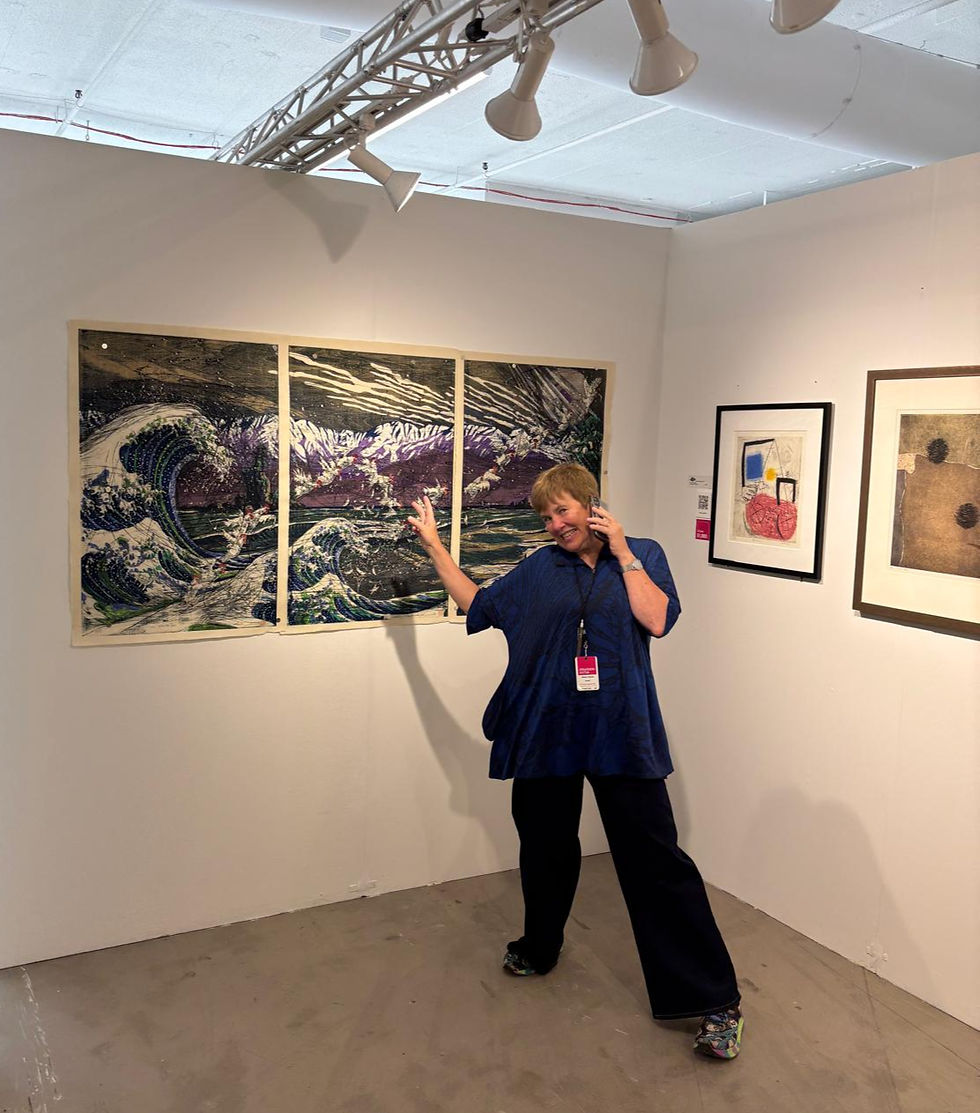
A few years ago, Kiyoyuki Fukuda, who works with us at the Tokyo gallery, happened upon several of Seiko KAWACHI's woodblocks tucked away in the gallery’s flat files. We had handled his work decades earlier and somehow lost touch over time. Kiyo was immediately struck by the joyful, chaotic energy running through the prints. He responded to the bold black lines, the vivid color, the sense of tension and movement that feels as though the image might burst beyond the edges of the paper.

He insisted we should include Kawachi-san’s work in our next Affordable Art Fair in New York. I loved the work immediately, but I admit I was slightly nervous about how our audience would respond. Kawachi’s riffs on traditional Japanese woodblock printmaking are exuberant, almost unruly at times, and because he is such a respected printmaking professor, the works are not inexpensive. But there was no reason to worry. Seasoned curators and first-time collectors alike responded instinctively to the work’s energy and confidence. People kept returning to the booth just to look again.
Kiyo also deserves credit for discovering another artist we recently added to the gallery: Sayaka KAWAMURA. Her work could not be more different from Kawachi’s, despite the fact that both artists work in woodblock. Kawamura-san’s palette is soft and muted, featuring pale pinks, smoky blues, and faded yellows, The women who populate her compositions often seem lost in thought, suspended somewhere between daydream and memory. There is a quiet psychological depth to her prints that people respond to almost immediately. One thing viewers frequently comment on is the scale of her female figures. Kawamura herself once explained it very simply: “I make large women because I want women to take up more space in the world.” I have always loved that statement. It is direct, generous, and quietly radical all at once.

In my role as both dealer and educator, I find it especially interesting to place artists like Kawachi and Kawamura side by side. They share the same printmaking technique, yet the results are entirely different. That is something I often emphasize when speaking with collectors: technique alone does not determine a work’s feeling or meaning. Woodblock is not a style; it is a language, and every artist speaks it differently.
Sometimes, when we begin showing a new artist, there is also the undeniable thrill of uncertainty. How will people respond? Will collectors connect with the work as deeply as we do? That sense of anticipation never completely disappears, no matter how long one has been doing this.
Last year, when Daisuke Maruoka introduced me to Tatsuo ICHIEN’s elegant abstract woodblocks, we all shared exactly that feeling. The works were restrained, luminous, and deeply refined; the kind of prints that reveal themselves slowly. We hoped people would respond to their quiet beauty, but none of us anticipated quite how enthusiastic collectors would be. The response was immediate and overwhelming, and the artist himself was astonished by the demand. At one point he laughingly admitted that he could barely keep up.

Those moments are deeply gratifying, not because something sells quickly, but because you feel that bridge being formed between artist and audience, between the solitude of the studio and the life the work will eventually have in someone’s home.
And so, every season, the process begins again. Looking, questioning, reconsidering, rediscovering. Searching for artists who move me emotionally first, and then intellectually. Artists whose work lingers in the mind after I leave the studio. In the end, that is really how I choose the artists we show: by showing others the works that stay in my mind long after I have stopped looking at them.
I hope I will always continue to feel excited by discovering new voices while also celebrating the artists with whom the Tolman Collection has decades-long relationships. So far, that delicate balance between discovery and continuity, between surprise and trust, seems to have served us (and our patrons) very well.