Building a Booth: Weeks of Planning, Four Days of Art
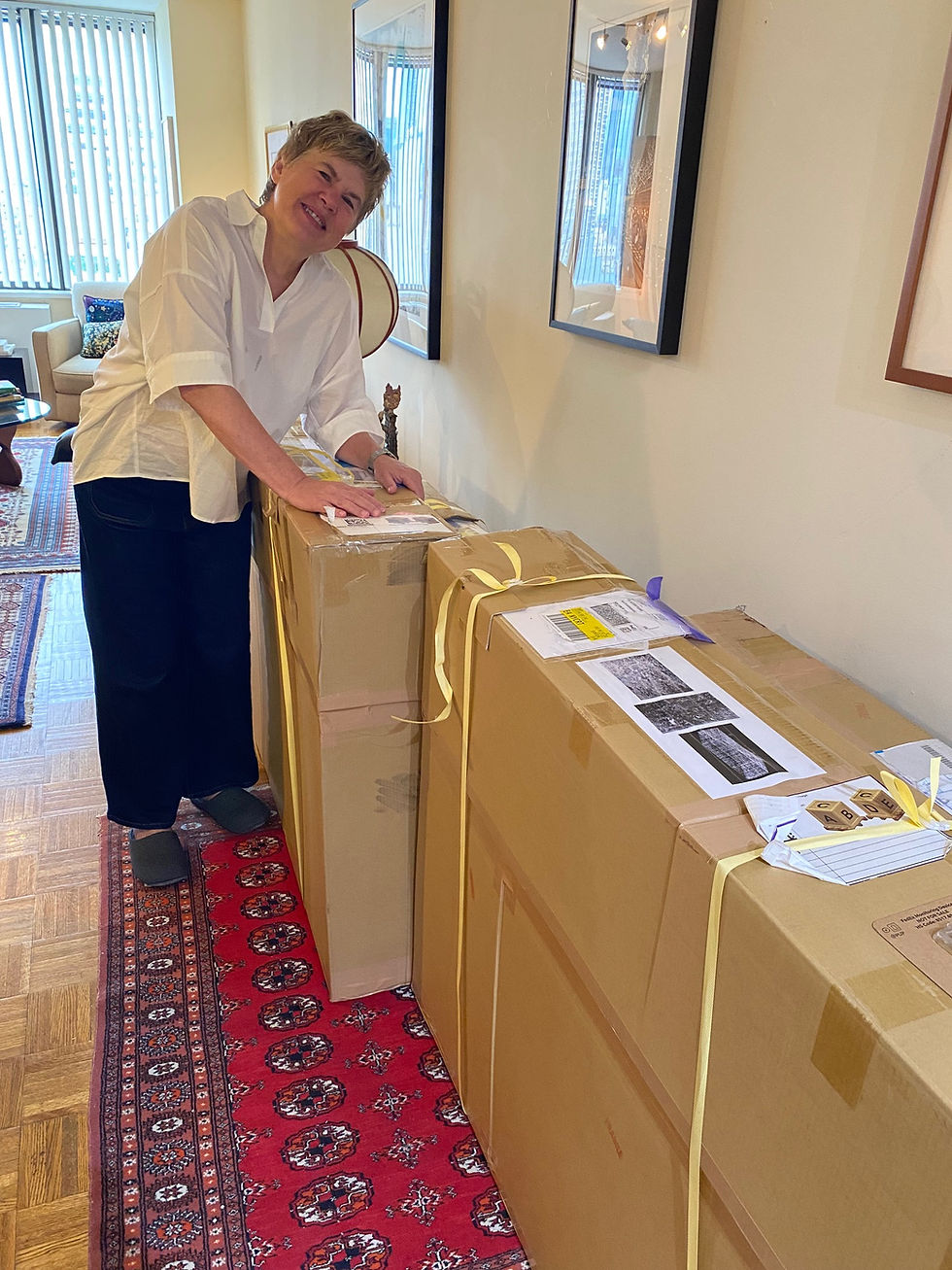
Since this month’s blog post auspiciously falls so close to the start of the 2026 art fair season, I thought this would be a good opportunity to give you a glimpse behind the scenes at what actually goes into getting ready for an art fair.
For any activity to have a successful outcome, planning and preparation are key; an art fair is certainly no exception. Those few days when you see me standing in a finished booth, surrounded by beautifully framed works and happily talking about artists, are actually the culmination of weeks (sometimes months) of decisions.
Once I have decided to participate in a fair, the most obvious question is which artists to bring and, perhaps even more importantly, which pieces of theirs should be displayed. This is not nearly as straightforward as it sounds.
Choosing work for an art fair is quite different from choosing work simply because I love it. I have many prints in the collection that I think are extraordinary, but an art fair creates its own peculiar environment. There are hundreds of works competing for attention. People are walking past booths, stopping, doubling back, talking to friends, looking at their phones, heading for lunch, and occasionally trying to remember where they saw that wonderful print half an hour earlier. An artwork sometimes has only a few seconds to persuade someone to stop. And therein lies one of the great balancing acts of preparing for an art fair…
There are certain artists who are what I would call “crowd pleasers.” In other words, I could hang their work in almost any booth, at almost any fair, and know that visitors will be drawn to it. There is something immediately appealing about their images, be it the color, the subject, the composition, the accessibility to new collectors, or simply the artist’s particular visual language. Those are, relatively speaking, the “easy” picks for any fair. They draw people to my booth.

Other artists I represent create work that I admire just as deeply, but which may not have the same immediate appeal to a broad audience. Their work sometimes asks a little more of the viewer: a deeper look, or the addition of a conversation with me: a little explanation about the technique, the artist’s background, the imagery or what makes a particular print so interesting.
Booth spaces come at a (hefty!) price, and every inch of wall is valuable real estate. What hangs on those walls matters. I don't want a piece of art taking up valuable wall space if it is never eventually going to find its way to someone else's home. But I also don't want to fill a booth only with the obvious choices. If I did that, I might have a perfectly successful fair from a commercial standpoint, but I would be leaving out one of the things I most enjoy about being an art dealer: introducing people to artists and wonderful works on paper that they didn't know they were looking for.
There is a real difference between an art fair booth and a gallery wall. A gallery exhibition allows you to establish a certain rhythm and gives the visitor time and space to absorb it. At an art fair, the booth itself has to make an impression from the aisle, at first glance. It has to invite people in without shouting at them. Individual works need to be strong enough to stand on their own, but they also need to live comfortably with their neighbors. It is a balancing act.
Too many strong images together and they can start competing with one another. Too many quiet ones and the booth can disappear into the visual cacophony of the fair. I think of it rather like seating people at a dinner party. You want interesting personalities, but you don't necessarily want all the loudest guests sitting next to one another while the introverts discreetly check their watches, hoping it will soon be time to go home.
Sometimes the unexpected pairings are the ones that work best. That is one reason I have occasionally enjoyed choosing a theme for a booth. Once it was The Wonderful World of Woodblock, an attempt to showcase how completely different the end results can be when a number of artists choose to work in the same medium. I particularly liked that idea because people sometimes think of “woodblock” as if it describes a particular look. Of course, it doesn't. The medium is simply the starting point. What individual artists do with it can be astonishingly different.
Another time, every framed piece hanging in the booth was by a woman printmaker. I enjoyed highlighting the remarkable range of approaches within the group. Their work moved across different printmaking techniques, from bold, deeply worked marks to delicate lines and subtle layers of tone and texture. There was strength alongside fragility, confidence alongside restraint. Some images felt forceful and immediate, while others revealed themselves slowly through fine detail and quiet observation. Seen together, the prints resisted any single idea of what work by women should look like; instead, they celebrated the individuality of each artist’s hand, process, and point of view.

Yet another time, I selected snow as the featured element. The snow theme was particularly fun because even a subject as seemingly simple as snow can produce an enormous variety of responses. Snow can be serene, graphic, abstract, nostalgic, lonely, beautiful, or even slightly ominous depending on the artist looking at it.
There is obviously a vast range of directions in which one can go. A theme can be based on medium, color, subject matter, season, or artist, or simply on a visual conversation that I think will make the works sing when they are placed next to one another. But, even when there is no formal theme, I want there to be some reason that the works are together. A booth should never look as though someone simply opened the storeroom door and grabbed the first twenty framed prints they could find. There also has to be a pleasing, yet not visually overwhelming, variety.
One of the pleasures of representing contemporary Japanese printmakers is the extraordinary range of work being produced. Someone may enter the booth because a large, colorful image catches their eye and then discover that what they actually respond to is a much smaller, quieter work. Another visitor may come looking for something figurative and fall in love with an abstract piece.
That happens more often than you might think. People frequently arrive at an art fair with a fairly firm idea of what they like. Then they encounter something that doesn't fit neatly into that category. That's when things become particularly interesting for me.
Part of the reason I enjoy fairs so much is precisely because they give me an opportunity to have those conversations. I want to talk with visitors about the art hanging on my booth walls, and I particularly enjoy the conversations about the work to which they may not initially have been drawn. Some of my favorite moments occur when someone pauses in front of a print and says, “I don't know why, but I keep coming back to this one.”
That is a lovely place to begin. We talk about the artist. We discuss how the work was made. We might attempt to explore what the visitor sees in it. Sometimes learning something about the technique, or the artist, completely changes the way someone looks at a print. Sometimes hearing what the artist was thinking or imagining when they made the piece does.
And sometimes nothing I say changes their mind at all. That's perfectly fine too. Not every work is for every person, nor should it be. But sometimes that visitor walks away, comes back an hour later and stands in front of the same print again. And sometimes that is the piece they buy.
There is a wonderful satisfaction in watching someone's relationship with an artwork develop in real time. The educational aspect of being a dealer has always been important to me. Selling the print is, of course, gratifying. Helping someone understand why a print is worth looking at is gratifying in a different way.
There are also some extremely practical matters with which to contend. I need to choose the art in a timely manner so that my framer has enough time to create the perfect enhancement for each image. Framing is enormously important. The frame is not supposed to be the first thing you notice. Its job is to allow the artwork to present itself at its best. The right mat, the right proportion, the right frame: all can subtly change the way we see an image. At an art fair, where the work is being viewed in an unfamiliar and often busy environment, that becomes even more important.
And these days, with supply chains occasionally subject to disruption, a framing order can take weeks, so it behooves me to plan early. Sometimes, while in a particularly organized mode, I have planned so far in advance that when I go to pick up the finished pieces, I am genuinely surprised by what I chose to frame. Never disappointed, mind you. But occasionally taken aback. “Oh! I framed that?” Several months earlier, I knew exactly what I was doing. A few days before a fair as I review, I find myself hoping that I actually did.
Then there are all the other details that nobody sees when walking through the finished fair: making lists, preparing labels and price information, checking condition, wrapping the art, packing it safely, arranging transportation and making sure that everything (including the things I am absolutely certain I will remember) is actually written down somewhere. Because inevitably there is something that I forget until the last minute, no matter how many times I have done this.
And then comes installation day. This is when all those decisions and checklists finally encounter reality. There is something both exciting and slightly unnerving about arriving at a fair, seeing what is essentially an empty box with bare walls and knowing that, in a matter of hours, it has to become The Tolman Collection of New York.
With the marvelous assistance of exhibition designer Dan Schnur, the booth begins to take shape. And inevitably, the plan changes. A print that looked perfect next to another one in my imagination suddenly doesn't. A large work needs more breathing room than I had thought. Something has to move higher. Something else lower. A large print dominates a wall more than anticipated. A small one unexpectedly holds its own. Something moves six inches. Then another six inches. A print comes down. Another goes up. And the piece we just moved six inches sometimes goes back exactly where it started.
This is part of the process. Eventually, however, there comes a moment when there is nothing left to move. I step out of the booth, walk a little distance away and turn around to take a look. And I am always delighted. In fact, at every fair I invariably think mine looks the best, though I do realize I may not be an entirely impartial judge. But, from your kind comments, it would seem that many of you think so too.
And then the doors open. This is the point at which all the planning in the world gives way to something I cannot plan at all: you. I never know which print is going to stop someone in the aisle. I never know which artist will provoke the most questions, which image will sell first or which piece everyone will admire but nobody will take home. Sometimes the work I was certain would sell immediately is still there at the end of the fair. Sometimes a print I hesitated to bring finds its person within the first hour. That unpredictability is part of what makes an art fair so interesting and makes my sore feet at the end of the day worth it.
For several days, my little temporary gallery becomes a meeting place. Old clients stop by to say hello. New visitors discover artists they have never encountered before. People bring friends back to show them something they fell in love with the day before. Someone who first tells me, “I'm just looking,” begins asking questions. And every so often, an artwork and a person find each other.
After all the selecting, framing, packing, carrying, hanging, moving, and re-hanging, that is really the point. The booth itself will exist for only a few days. Then the walls come down, the fair disappears and we all go home. But the art that leaves the booth for a new home may hang there for decades. That is a rather satisfying return on all my planning.

For those of you reading this as soon as the blog is posted, I hope to see many of you at the upcoming Affordable Art Fair at the Starrett-Lehigh Building. For those of you coming across this at a later date, please take a look at my homepage and see in what fair I might currently be participating.
All of you who attend an art fair and come across a Tolman Collection booth, please stop and say hello, and have a look at what prints made the cut, this time anyway because each booth is different. And if there is a piece on the wall that you don't quite understand (or one you find yourself returning to for reasons you can't quite explain) please ask me about it. I will have a lot to share with you.
Those are often the most interesting conversations of all for me, and the most satisfying purchases for many of my visitors who have fallen in love with a piece and want to take it home.


