The Next Chapter of a Collection
Updated: Jun 13

One of the unexpected things about spending a lifetime in the art world is that you begin to see collections not as static groups of artworks, but as living organisms.
Let me explain. When I was growing up in Tokyo, surrounded by my parents' personal collection and the gallery they eventually built from it, I thought about art the way most young people do. The works were simply there. Some had been purchased, others had been gifts from artists, and still others simply had been around forever. They hung on the walls of our home, leaned against bookshelves, emerged from flat files, disappeared into exhibitions, and returned again or were replaced by other acquisitions.
Only later did I realize that every collection tells a story. Not just the story of the artists and the pieces, but the story of the person who assembled it. When I visit a collector's home, I can tell within minutes whether they are drawn to boldness or restraint, abstraction or narrative, color or line. A collection becomes a portrait of a life spent looking. It records what moved someone, what they valued, what they were curious about. It is a visual timeline of someone’s life and of how someone’s tastes and emotions have evolved over the years.
Many of the collectors I work with today have been collecting contemporary Japanese prints for decades. Some purchased their first works from my parents’ gallery in Tokyo in the 1970s or 1980s. Others discovered Japanese printmaking much later, perhaps through an art fair participation of mine or a visit to the gallery. What they all have in common is that their collections eventually become something larger than the individual works themselves.
A collector might begin with a single Toko Shinoda lithograph because they were captivated by the elegance of her brushwork. Then perhaps they acquired a Yuichi Hasegawa woodblock because its quiet geometry spoke to them in a different way. Years later, a luminous Yoshikatsu Tamekane entered their collection, followed by a pastel, dreamlike Sayaka Kawamura. Without consciously planning it, they thus assembled a visual autobiography of brief moments in their life.
And then, one day, a question occurs: "What do I do with my collection?" It is one of the most important questions a collector can ask, and one that surprisingly few people think about until very late in the process of acquiring art.
The truth is that collections often outlive their creators or sometimes their creators’ interest. Sometimes a collection gets a little too big. Children may love their parents but not share their passion for contemporary Japanese prints. People downsize their homes. Priorities change. Tastes change and evolve. Collections that took decades to build need to be reconsidered. Shrines to the past suddenly need a future.
Some collections are dispersed at auction. Some return to the market in dribs and drabs through galleries and dealers. Some are divided among family members, each taking the pieces that most resonate with their family memories, creating mini collections that then evolve from the focus of the original assemblage and mutate into something different. And some find their way into museums.
MFA Boston curator of Japanese prints Sarah Thompson showing off some recent donations
I have always found the museum path especially meaningful. There is something touching about knowing that a print that once hung above a dining room table might someday be studied by a graduate student, exhibited for an engaged public, or encountered by a visitor who has never before seen an example of contemporary Japanese printmaking and falls in love.
In many ways, museum collections and private collections are not as different as people imagine. Both begin with someone looking closely and deciding that a specific work of art matters. The difference is that museums extend that act of care across generations and for a larger audience.
What encourages me most is that interest in my specific area of expertise continues to grow. For many years contemporary Japanese printmaking occupied a somewhat overlooked position within museum collections and curators were understandably focused on ukiyo-e, the great historical tradition of Japanese printmaking. Today, however, institutions increasingly recognize that the story did not end with Hiroshige and Hokusai. And artists such as Toko Shinoda, Yoshikatsu Tamekane, Yoshio Imamura, Noriko Saitō, Sayaka Kawamura, and Katsunori Hamanishi certainly represent an ongoing and evolving conversation that deserves preservation and study.

Over the years, I have had the pleasure of collaborating with curators at institutions that actively collect modern and contemporary Japanese art. The National Museum of Asian Art in Washington, D.C. has built an extraordinary collection of Japanese works on paper. The Asian Art Museum in San Francisco continues to expand its holdings of contemporary Asian art while connecting it to centuries of artistic tradition. The Minneapolis Institute of Art, the Portland Art Museum, the Museum of Fine Arts, Boston, the Harvard Art Museums, the Virginia Museum of Fine Arts, the Jordan Schnitzer Museum at the University of Oregon and the Art Institute of Chicago have all demonstrated sustained commitment to contemporary Japanese works on paper.
The Cincinnati Art Museum, thanks to the generosity of the wonderful Mrs. Caroline Porter, who began her collection during a visit to Tokyo during the Occupation, has a major collection of contemporary Japanese prints and that passion has now extended to the 4th generation of her family. Curator of Prints Kristin Spangenberg has stewarded the collection with dedication for decades, occasionally mounting exhibitions and always making the prints available for viewing by appointment, as is the case for all public institutions.
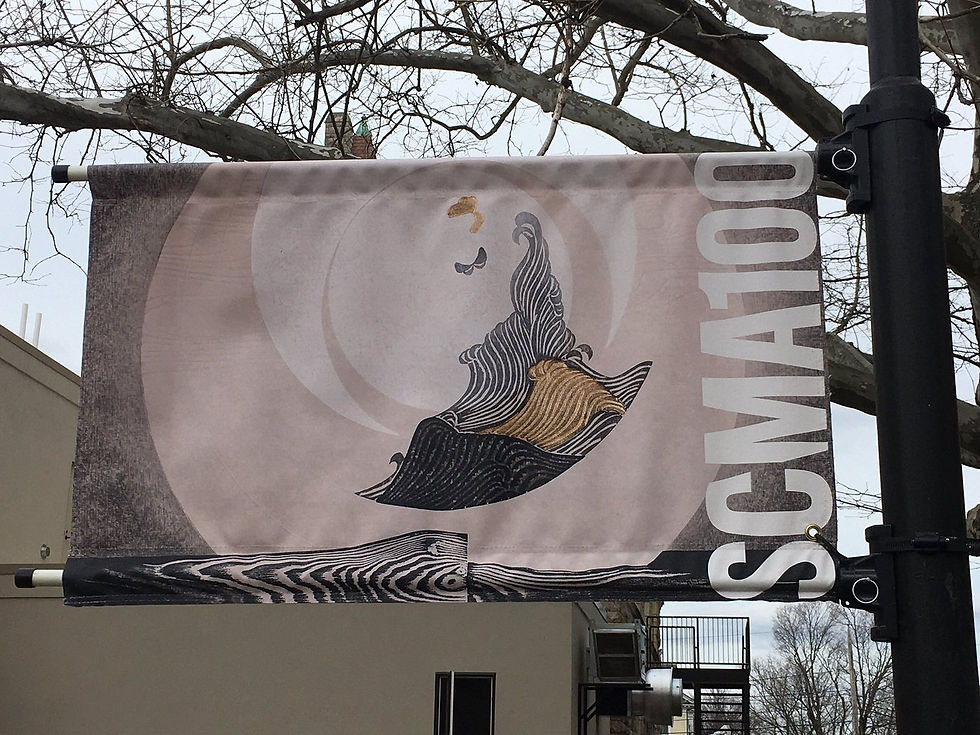
Another example that is obviously particularly close to my heart is the Hilary Tolman Collection of Twentieth-Century Japanese Prints at the Smith College Museum of Art. What began as gifts from The Tolman Collection in honor of one of my sister’s class reunions has grown over the years into a significant resource for the study of postwar and contemporary Japanese printmaking. Working closely with Aprile Gallant, Associate Director of Curatorial Affairs/Senior Curator of Prints, Drawings, and Photographs, the collection (so far) includes 144 works, allowing students, scholars, and visitors to engage directly with contemporary Japanese works on paper. The museum has described the collection as one of the strongest college holdings of postwar Japanese prints in the United States, and seeing these works used for teaching, exhibitions, and research has been enormously gratifying. It is a wonderful example of how a private passion for collecting and sharing can evolve into a public resource that continues to educate and inspire long after the works leave the walls of a private home.
One misconception I frequently encounter is that museums only want unique masterpieces. That is rarely the case. Curators often value context as much as individual importance. A museum may be deeply interested in a carefully assembled group of works by a single artist that demonstrates the evolution of a career. It may be interested in a collection that specifically documents the development of contemporary Japanese woodblock printing over several decades. It may value a collector's unique vision and wish to preserve that perspective intact. Sometimes a collection matters because of the relationships between the works. Sometimes it matters because of the person who assembled it.
This is where dealers such as I can play a significant role as go-between, marrying a specific collection, or pieces from a collection, with a particular institution. Because I spend much of my time speaking with artists, collectors, and curators, I often know where there may be opportunities for a collector to make the greatest impact. A collector who has spent thirty years acquiring prints by women artists may find that a particular museum is actively seeking to strengthen that area of its holdings. Another collector may have assembled an exceptional group of works by a single artist that fills an important gap in an institution's existing collection.
Finding the right home requires patience, conversation, and planning; it is not something to leave until the last moment. In fact, some of the most successful donations begin years before the gift itself. Collectors lend works to exhibitions, meet curators, develop relationships with institutions, and gradually determine where their collection might have the most meaningful future.
Sometimes, however, a curator acquires a work to commemorate a particular event, such as the case of a silkscreen/woodblock by Tetsuya Noda, created during the COVID-19 epidemic. The piece depicts the artist and his wife, both masked and holding masks, looking out at us and beyond us. When Noda-san first sent me a photograph of this piece, I felt strongly that it belonged on public view and approached several museum curators, all of whom agreed with me. In the case of the Metropolitan Museum, the acquisition was especially fitting: Noda’s oeuvre is concentrated on his Diary series, with each edition titled with the date of its creation. Dr John Carpenter, the Mary Griggs Burke Curator of Japanese Art, mentioned that the date of the work, Diary March 13th ‘20, was the date when the Metropolitan Museum closed because of the pandemic.

I often think back to something my parents taught me, without ever really stating the lesson aloud. Art enters our lives in many ways, but it rarely belongs entirely to us. The artist creates it, the printer helps bring it into existence, the gallery places it into the world, and the collector lives with it for a time. Each person becomes part of the work’s story. Perhaps that is why I have never thought of collectors as owners so much as dedicated caretakers. Their stewardship may last five years or fifty years, but eventually the work moves on and continues its journey. The question is not whether that will happen: it is where the next chapter will be written and if the collector will be the one to write it.
A collection begins with a single work that catches someone's eye and ignites a passion. Its final chapter may be helping thousands of people to see what that person saw. For those who have spent a lifetime building a collection, donating works to a museum can be one of the most fulfilling acts imaginable. It ensures that the curiosity, passion, and commitment that shaped their collection continue to benefit others. What better way to be remembered than through human connection via the arts and philanthropic generosity?


